





Many people are deterred from buying electric vehicles (EVs) by a primary fear: the exorbitant cost of replacing the battery should it fail. This myth has spread widely, painting the main battery (traction battery) as a ticking time bomb that could suddenly leave the owner facing a massive financial hit.
However, real-world data tells a different story. A recent study by Warrantywise, a UK-based vehicle warranty provider, reveals that major EV battery failures are actually extremely rare. So, which components are the ones that most frequently break down and drain your wallet?
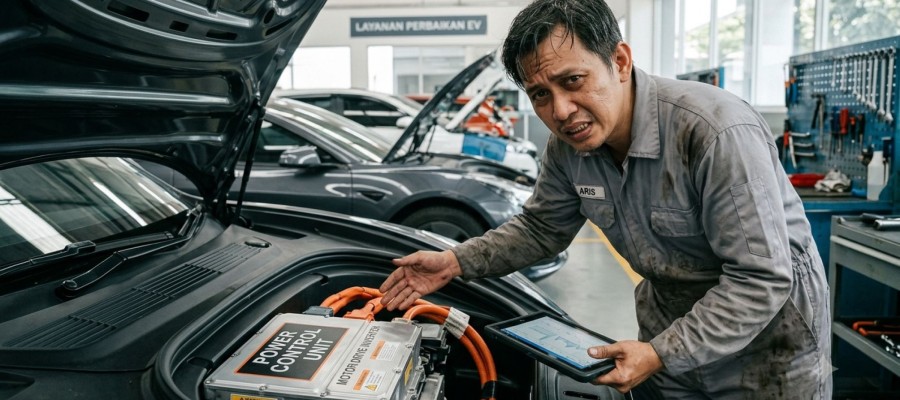
If there is one specific EV component that poses the biggest risk to your finances when it fails, it is the On-Board Charger (OBC). The OBC converts AC power (such as from a household outlet or wallbox) into DC power to charge the high-voltage battery. According to Warrantywise data reported by Carscoops, the cost to replace or repair this component ranges from IDR 52.2 million to IDR 252.9 million—an astronomical figure for an internal electronic component!
Why is it so expensive? The OBC is a high-tech power conversion system that operates under stress every time the car is charged at home; consequently, replacing the unit entails high costs for both the part itself and the specialized technician required for the job.
Contrary to fears about the main battery, the issues most frequently reported by EV owners actually relate to the general electrical system and the 12V battery (the conventional battery). Components such as sensors, central locking mechanisms, and internal electronic modules dominate the list of repair claims. Additionally, the 12V battery—which powers lights, infotainment screens, and support systems—often drains or fails prematurely without the owner realizing it.
The mechanical issues that most frequently plague electric vehicles actually stem from the suspension system. Electric vehicles are known for their significant weight, largely due to the heavy battery packs they carry. This added mass places extra strain on suspension components—such as control arms (wishbones) and bushings—as they support the load and absorb road shocks. Consequently, EV suspension systems are far more prone to wear and tear. Regarding repairs, Warrantywise notes that suspension-related claims can reach as high as £4,100 (approximately IDR 99.1 million).
Source: Carscoops
<< Back